Organize and Protect Your Digital Legacy Before Someone Else Needs Access.
Your digital legacy is the collection of accounts, information, assets, memories, and online relationships that make up your digital life, which would be lost if neither you nor anyone else was able to access them.
The Digital Legacy Tree™ model is a framework that helps individuals and families organize digital accounts, important information, and online assets so loved ones can access what matters most during an emergency, incapacity, or after your death.
Why Your Digital Legacy Matters
Digital Accounts
Important Information
Photos, documents, financial records, family history, devices, and digital assets can be difficult to locate or access during an emergency or after death.
Family Preparedness
How the Digital Legacy Tree Model works
One of the main reasons people neglect their digital legacy plan, or never start one, is the expectation that it is a big job that will take a lot of time and focus. That's because many experts make the first step the hardest... creating a full inventory of all your accounts and assets. This is demotivating and unnecessary, especiallly when you want to make sure the most important assets are in order first.
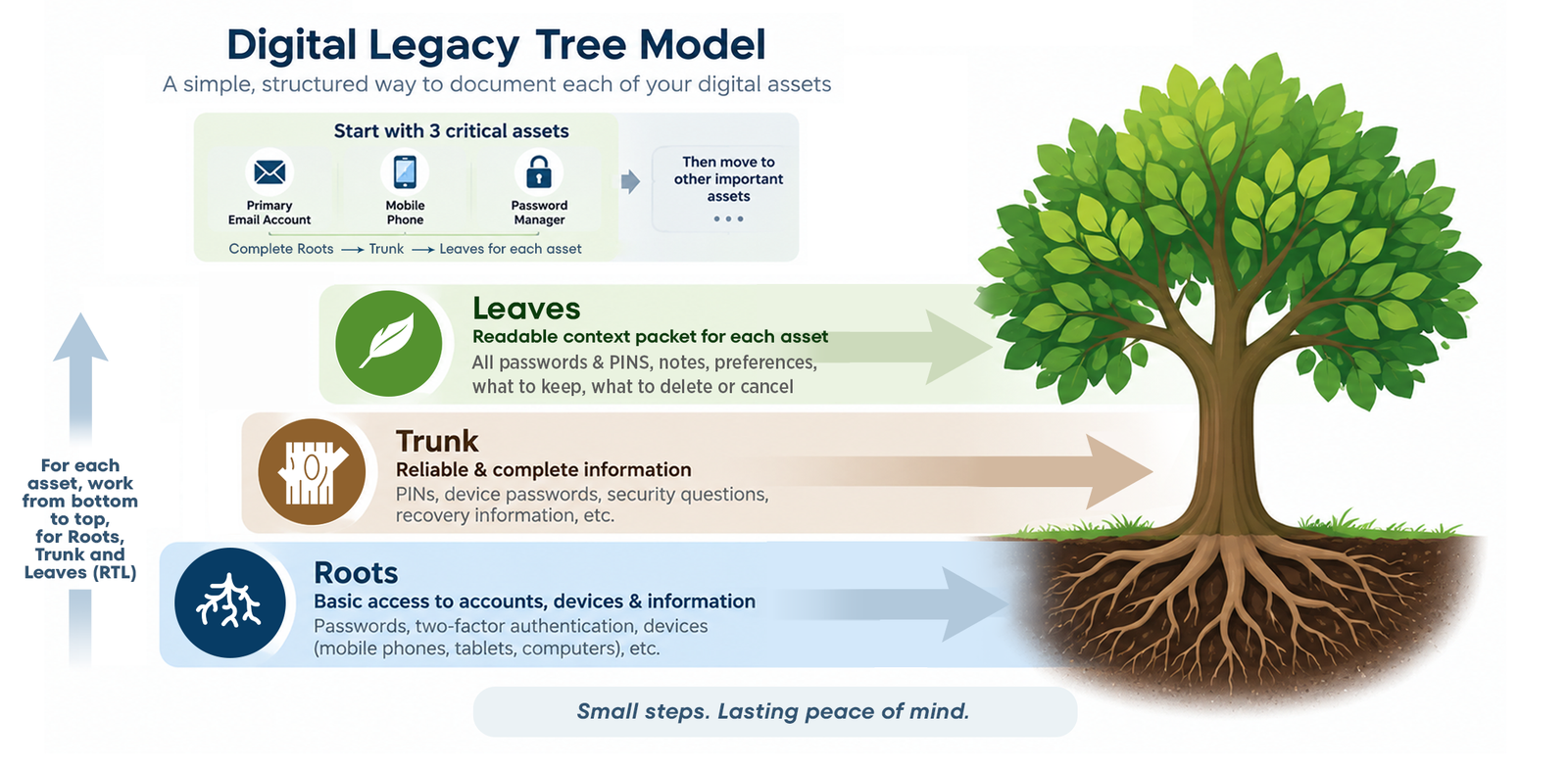
The Digital Legacy Tree model provides an easy way of organizing your important digital information before it is needed. It helps individuals and families avoid the stress, confusion and frustration of trying to guess at what's important, how to access it, and what it means to you.
1) Identify Your Key Assets
The Roots - Start by identifying and documenting your 3 most important accounts, devices and password repositories, as well as assigning emergency recovery contacts for them.
2) Organize for Reliability
The Trunk - Document the information your loved ones may need in a way that anticipates and removes any confusion or barriers.
3) Provide Usable Context
The Leaves - Ensure trusted people know what exists, where to find it, and what the context and priority are, as well as creating a Digital Trailhead™ so they can know where to start.
What belongs in your Digital Legacy Tree?
Your digital legacy tree has a number of components. It's not just about telling somebody where your passwords are.
First, are the "tree" components themselves that are built incrementally using "metadata", or information about your most important digital assets. You start from the highest priority ones, working down in priority as you are able to make time for them. This way, you know that the most important information is documented in well-organized records, and ready to use. Then, you add certain information to each of them to make them more reliable and usable.
Online Accounts
Email, social media, cloud services, subscriptions, and online tools.
Mobile Devices
Phones, tablets, computers, storage devices, and authentication tools.
Password Repositories
Non-sensitive informtion about password managers and secure storage locations for access in emergencies.
Other Digital Assets
Cryptocurrency, websites, domain names, and digital businesses.
Personal Legacy
Photos, videos, stories, collections, and important memories.
Family Information
Emergency contacts, trusted individuals, instructions, and responsibilities.
To make your Digital Legacy Tree usable, without confusing or frustrating those who need to access these assets, you need to put them into a Digital Legacy File™ with a clear starting point, called a Digital Trailhead™. This will let them know where to start, and the order of importance.
Ready-To-Use Resources
Explore practical tools, checklists, guides, and articles designed to help you identify assets, organize information, and prepare trusted people to access what matters most.
Here are a few of the tools you'll be able to learn about or access on the Digital Legacy Resources page.
Every platform is different in how it enables you to set up emergency contacts (or doesn't).
As an example, you'll find a simple set of procedures for setting up a password manager to securely store your passwords and other sensitive information.
After you've documented your top 3 critical accounts devices or files, you will want to identify other types of digital assets. This easy checklist will help you remember which ones you might have, and are worth documenting.

Frequently Asked Questions About Digital Legacy Planning
What is a digital legacy?
Your digital legacy is the collection of digital assets, accounts, information, and personal content that you leave behind or become unable to manage yourself.
A digital legacy can include email accounts, social media profiles, cloud storage, smartphones, computers, online subscriptions, cryptocurrency, websites, digital purchases, family photos, important documents, and even the passwords needed to access them.
Most people accumulate hundreds of digital assets during their lifetime, but very few have a clear plan for how trusted family members, executors, or caregivers can find or manage them during an emergency, incapacity, or after death.
The Digital Legacy Tree™ model helps individuals and families identify important digital assets, organize essential information, and provide trusted people with the context they need to access what matters most when it matters most.
Digital legacy planning is not just about preparing for death. It is also about reducing confusion, stress, and lost information during unexpected life events while preserving the digital records, memories, and knowledge that matter to your loved ones.
What happens to online accounts when you die?
The fate of your online accounts depends on the provider, your local laws, and whether you left clear instructions for family members or executors.
Some services, such as email providers, social media platforms, cloud storage services, and financial websites, offer options for memorialization, account closure, or limited access by authorized individuals. Others may require legal documentation before providing any information. In many cases, loved ones cannot simply access an account, even if they know it exists.
The challenge is often not the accounts themselves. It is knowing which accounts exist, why they matter, where important information is stored, and how trusted people can access what they need when appropriate.
Without a plan, family members may spend weeks or months trying to locate online accounts, recover important information, cancel subscriptions, preserve photos and memories, or determine whether valuable digital assets exist. Some information may never be recovered.
The Digital Legacy Tree™ model helps address this challenge by providing a practical way to identify important accounts, organize essential information, and give trusted people the context they need to manage your digital life when you are no longer able to do so yourself.
Digital legacy planning is not just about preparing for death. It also helps families respond to unexpected emergencies, illness, injury, or incapacity, when timely access to important digital information can be just as critical.
What counts as a digital asset?
A digital asset is any information, account, file, service, or item of value that exists in digital form and may need to be accessed, managed, transferred, preserved, or closed by someone you trust.
Many people think of digital assets as cryptocurrency or online financial accounts, but the reality is much broader. Digital assets can include email accounts, social media profiles, cloud storage services, photos and videos, online banking accounts, password manager vaults, domain names, websites, digital businesses, loyalty programs, subscription services, digital purchases, and important documents stored electronically.
Some digital assets have clear financial value, while others have personal, legal, or sentimental importance. For many families, the most valuable assets are not financial at all. They may be family photos, personal correspondence, genealogy research, creative works, journals, or information that helps loved ones manage responsibilities during a crisis.
A common challenge is that family members often do not know which digital assets exist, where they are stored, why they matter, or how to access them when needed. As a result, valuable information can become inaccessible, overlooked, or permanently lost.
The Digital Legacy Tree™ framework helps individuals identify their most important digital assets, organize essential information, and document the context trusted people need to understand what exists and what actions may be required. By treating digital assets as part of a larger digital legacy, families can reduce confusion, preserve important memories, and improve preparedness for emergencies, incapacity, or death.
Understanding what counts as a digital asset is often the first step toward discovering how much of your life now exists in digital form, and why a thoughtful plan can make a significant difference for the people you care about most.
How is a Digital Legacy Tree different from a will?
A will is a legal document that explains how your property and assets should be distributed after your death. A Digital Legacy Tree™ is a practical framework for organizing the digital accounts, information, assets, instructions, and context that trusted people may need to access before or after that time.
While a will can identify beneficiaries and provide legal authority, it typically does not contain the detailed information needed to locate online accounts, manage subscriptions, recover important documents, preserve digital memories, access devices, or understand the purpose and importance of specific digital assets. In many cases, including passwords directly in a will is not advisable because wills may become part of the public record and the information changes frequently.
A Digital Legacy Tree complements a will by helping you identify what exists, where it can be found, why it matters, and how trusted individuals can access or manage it when appropriate. It can include information about online accounts, password management, devices, digital assets, important contacts, family information, personal legacy materials, and other resources that loved ones may need during an emergency, incapacity, or after death.
Perhaps most importantly, a will generally becomes relevant after death, while a Digital Legacy Tree can provide value much earlier. It can help families respond to illness, injury, travel emergencies, caregiving situations, cognitive decline, or any circumstance in which someone else may need to access important information on your behalf.
The most effective approach is often to use both. A will can provide the legal instructions, while a Digital Legacy Tree provides the practical guidance and context needed to help trusted people carry out those wishes and manage your digital life responsibly.
By combining legal planning with digital preparedness, families can reduce uncertainty, avoid unnecessary delays, and ensure that important information, assets, memories, and responsibilities are not overlooked when they matter most.
Should passwords be included?
Passwords are often one of the most important parts of digital legacy planning, but they should usually not be stored directly within a Digital Legacy Tree itself. Instead, the Digital Legacy Tree™ should help trusted individuals understand what accounts exist, where access information is stored, and how authorized access can be obtained when needed.
Many people maintain dozens or even hundreds of online accounts, including email, banking, social media, cloud storage, shopping platforms, and subscription services. Without access to these accounts, loved ones may struggle to locate important information, manage ongoing responsibilities, recover valuable records, or preserve meaningful photos and memories.
The challenge is balancing accessibility and security. Passwords change over time, and storing them in unsecured documents can create significant risks. For most people, a password manager such as Bitwarden, 1Password, Dashlane, or Keeper provides a more secure way to store and maintain account credentials. A Digital Legacy Tree can then document where these credentials are managed, who should have access, and what information is most important during an emergency, incapacity, or after death.
Just as important as the passwords themselves is the context surrounding them. Trusted family members or executors often need to know which accounts matter, why they matter, whether they contain financial assets, family records, subscriptions, business information, or personal memories, and what actions may need to be taken.
The Digital Legacy Tree framework focuses on organizing that broader picture. Rather than creating a simple list of passwords, it helps individuals and families build a structured, secure, and maintainable approach to digital preparedness, making it easier for loved ones to find, understand, and responsibly manage important digital information when it matters most.
Many people discover that the biggest challenge is not remembering passwords but understanding the full scope of their digital life. Creating a Digital Legacy Tree is often the first step toward identifying what exists, what is important, and how trusted people can access what they need without compromising security.
What is a digital executor?
A digital executor is a trusted person who helps manage aspects of your digital life when you can no longer do so yourself, whether because of incapacity or after death. Depending on local laws and the authority granted through your estate planning documents, a digital executor may help locate important accounts, preserve valuable information, close unused services, recover digital assets, and coordinate access to digital records on behalf of your family or estate.
Today, many people have dozens or even hundreds of digital assets, including email accounts, cloud storage, social media profiles, online subscriptions, websites, password managers, digital purchases, and financial accounts. Without clear guidance, even close family members may be unaware of what exists, where information is stored, or which accounts require attention.
A digital executor's role is often less about technical access and more about understanding context. They may need to determine which accounts contain important documents, preserve family photos and memories, identify recurring payments, locate digital assets with financial value, or work with service providers that have specific policies for deceased or incapacitated users.
The Digital Legacy Tree™ model uses the term Authorized Decision-Maker when referring to any trusted individual such as a digital executor. The model makes it easier for people in this role by providing a structured and repeatable way to identify important accounts, organize essential information, document responsibilities, and communicate instructions before they are needed. Rather than leaving loved ones to piece together a complex digital life during a stressful time, a Digital Legacy Tree helps ensure that trusted individuals know what exists, why it matters, and where to begin.
Importantly, a digital executor is not only relevant after death. Many of the same challenges arise during illness, injury, cognitive decline, caregiving situations, or other circumstances where someone temporarily or permanently needs assistance managing digital information on your behalf. For example, a designated Power of Attorney often needs to be able to access your digital assets in order to maintain them according to your wishes or best interests.
By identifying Authorized Decision-Makers for your digital estate and documenting critical information in advance, families can reduce confusion, avoid unnecessary delays, and help ensure that important digital assets, records, and personal memories are not overlooked when they matter most.
Who should create a Digital Legacy Tree?
Anyone who relies on technology to communicate, manage information, store memories, conduct business, or access important services can benefit from creating a Digital Legacy Tree™.
Many people assume digital legacy planning is only for seniors or those engaged in formal estate planning. In reality, almost everyone has a digital life that would be difficult for others to understand or manage without guidance. Email accounts, smartphones, cloud storage, social media profiles, online subscriptions, financial services, password managers, digital purchases, and personal records are now part of everyday life for people of all ages.
A Digital Legacy Tree can be particularly valuable for:
- Parents who want family members to access important information during an emergency.
- Professionals who manage significant personal and business information online.
- Small business owners, consultants, and entrepreneurs who rely on digital services and online accounts.
- Caregivers supporting aging family members.
- Retirees who want to preserve important records, memories, and instructions.
- Anyone responsible for family photos, genealogy research, personal collections, or other information that could be difficult to recover if something unexpected happens.
Importantly, a Digital Legacy Tree is not just about planning for death. It can also help families respond to illness, injury, hospitalization, travel emergencies, cognitive decline, or any situation in which someone else may temporarily or permanently need access to important information.
The more digital aspects of your life you accumulate, the more valuable it becomes to document what exists, what matters, and how trusted people can find the information they may need. Many people are surprised to discover that they have dozens, or even hundreds, of accounts, devices, subscriptions, documents, and digital assets that no one else knows about.
The Digital Legacy Tree™ framework provides a practical way to identify and organize that information before it becomes urgent. Whether your goal is protecting digital assets, preserving personal memories, supporting loved ones, or simply improving preparedness, creating a Digital Legacy Tree can help reduce confusion and make it easier for trusted people to help when it matters most.
How often should it be updated?
Depending on how quickly your digital life changes, a Digital Legacy Tree™ should be reviewed at least once or twice a year and whenever a significant life, family, financial, or technology change occurs.
Unlike a traditional estate plan that may remain unchanged for many years, our digital life tends to be constantly evolving. New accounts are created, devices are replaced, passwords change, subscriptions are added or cancelled, and important documents are moved or updated. A Digital Legacy Tree that is accurate today may be incomplete a year from now, or even in a few months, if it is not reviewed periodically.
Many people find it helpful to update their Digital Legacy Tree during an existing annual routine, such as tax preparation, year-end financial reviews, estate planning reviews, or New Year's planning. Regular updates help ensure that trusted individuals can rely on the information when it is needed most.
You should also consider updating your Digital Legacy Tree after major events such as:
- Marriage, separation, divorce, or the death of a loved one
- The birth or adoption of a child
- Retirement or a significant career change
- Starting or selling a business
- Moving to a new home or country
- Creating or disposing of online accounts or digital assets
- Adopting a new password manager or changing your access strategy or primary cloud storage platform
- Purchasing cryptocurrency, websites, domain names, or other digital property
Importantly, updating a Digital Legacy Tree is not simply about adding new accounts. It is also about reviewing priorities, trusted contacts, responsibilities, and the instructions that provide context for loved ones. In many situations, knowing why something is important can be just as valuable as knowing where it is.
The goal is not perfection or exhaustive documentation for every account you own. The goal is maintaining a useful, trusted roadmap that helps family members, caregivers, executors, or other trusted individuals understand your digital life and respond effectively if an emergency, incapacity, or death occurs.
Many people are surprised to discover that the process of reviewing their Digital Legacy Tree each year helps them identify forgotten accounts, outdated information, unused subscriptions, security risks, and gaps in their overall preparedness. Regular updates can improve both digital security and family readiness while ensuring that important digital assets, information, and memories are not overlooked when they matter most. Reviewing it regularly can also save you and your loved ones time when it matters most.
You probably have other questions for your own situation. Everyone's situation is a little different...
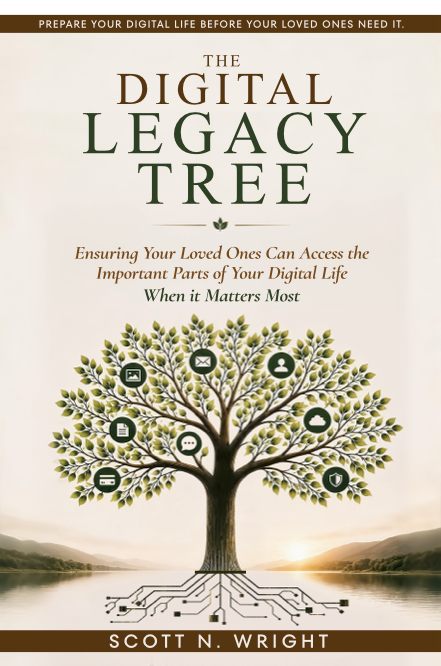
Looking for a step-by-step approach? Learn more about The Digital Legacy Tree book.
Stay Informed